How Much Bandwidth Does VoIP Need? Internet Requirements for Business VoIP
August 25, 2026
What Businesses Need to Know
WhatsApp has become an important customer communications channel for businesses around the world. Companies increasingly use the WhatsApp Business Platform for customer service, appointment notifications, transactional updates, authentication and other business communications.
Beginning October 1, 2026, Meta is changing how some of those messages are charged.
The change is particularly important for organizations using WhatsApp for customer service and contact center interactions, because messages that currently do not incur a Meta messaging fee will become billable.
For businesses handling a significant volume of customer conversations, understanding the change now is important for forecasting future WhatsApp Business API costs.
Here’s what is changing, what remains the same, and what it could mean for your customer service operation.
What’s Changing in WhatsApp Business API Pricing on October 1, 2026?
The biggest change involves Service messages.
A Service message is a non-template message sent by a business while a 24-hour customer service window is active.
Beginning October 1, Meta will charge businesses on a per-message basis for Service messages.
This is a significant change because these messages currently do not incur Meta messaging fees.
Consider a simple customer service interaction:
Customer: “Hi, I need help with my account.”
Agent: “Of course. How can I help you today?”
Customer: “I need to change my billing information.”
Agent: “I can help with that. Let me pull up your account.”
Today, those normal free-form responses from the agent do not generate Meta messaging fees while the customer service window is active.
Beginning October 1, each outbound Service message sent by the business will become billable.
The customer’s inbound messages will not become billable Meta messages as part of this change.
For businesses using WhatsApp primarily for inbound customer service, that distinction matters.
Utility Messages Are Also Changing
Service messages aren’t the only category affected.
Meta will also change how Utility template messages are charged inside an active customer service window.
Utility templates are transactional messages related to an existing customer interaction or transaction. Examples can include:
- Order confirmations and updates
- Appointment information
- Billing notifications
- Payment updates
- Transaction status messages
- Account-related notifications
Under the current pricing structure, Utility templates sent outside an active customer service window are billable.
However, Utility templates sent inside an active 24-hour customer service window currently do not incur Meta’s messaging fee.
Beginning October 1, 2026, that exemption ends.
Utility template messages will be billable whether they are sent inside or outside the customer service window.
For businesses that frequently use Utility templates while assisting customers, this is another area where WhatsApp messaging costs may increase.
How Much Will WhatsApp API Messages Cost After October 1?
This is probably the most important question for businesses planning their 2026 messaging budgets.
WhatsApp Business Platform does not have one universal worldwide message price.
Meta’s messaging rates can vary according to factors such as:
- Message category
- Recipient market
- Messaging volume
- Applicable volume tiers
- Other Meta pricing rules
Under the October pricing structure, Service messages will join other billable business messaging activity on a per-message basis.
That means businesses should begin thinking about WhatsApp costs in terms of outbound message volume, not simply the number of customer conversations.
For example, two companies could each handle 10,000 WhatsApp customer conversations per month but have very different costs if one averages three outbound messages per interaction and the other averages twelve.
The number of messages required to resolve a customer interaction will therefore become more relevant when estimating WhatsApp API costs.
Businesses should consult Meta’s current rate card for the applicable country and message category when calculating their expected costs, as rates can vary by market and may change over time.
WhatsApp API Pricing Today: A Quick Comparison
Understanding today’s pricing helps illustrate why the October change matters.
Currently, when a WhatsApp user sends a business a message, a 24-hour customer service window opens. Each new inbound message from the customer refreshes that window.
While the window is active, businesses can send normal free-form Service messages without a Meta messaging fee.
Utility templates sent during that active window also currently do not incur a Meta messaging fee.
Under the current WhatsApp Business API pricing structure, these messages do not incur Meta’s messaging fee while the customer service window remains active.
Other template categories work differently.
Marketing templates are already billable.
Authentication templates are already billable.
Utility templates sent outside the customer service window are already billable.
So the October update isn’t simply a new WhatsApp pricing system replacing everything that exists today.
Instead, Meta is removing two important pricing exemptions that customer service organizations currently benefit from.
WhatsApp API Pricing: Today vs. October 1, 2026
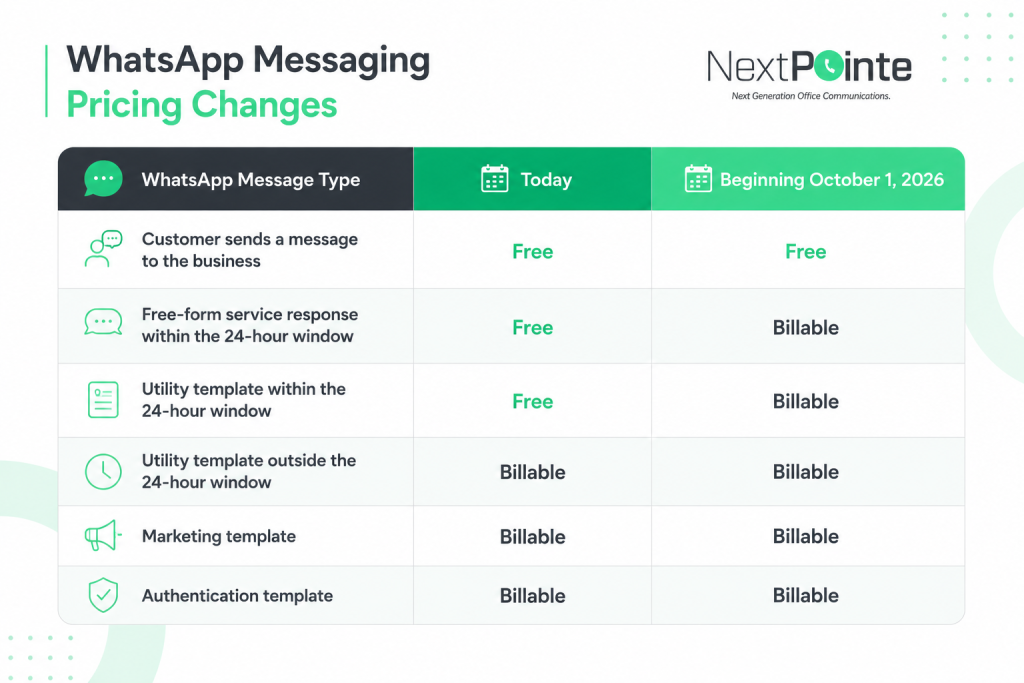
For many businesses, the most important lines in that table are the first three.
The customer can still initiate a WhatsApp interaction without generating a Meta inbound messaging charge, but the business responses that follow will begin generating per-message charges starting October 1.
One Important Exception: Free Entry Points
Meta is maintaining an important exception for conversations originating from certain free entry points.
When a customer initiates a WhatsApp conversation through an eligible Click-to-WhatsApp Ad or Facebook Page call-to-action button, special free-entry-point rules can apply.
If the business responds within the required initial period, a 72-hour free entry point customer service window can open. During that window, eligible messages can continue without Meta messaging charges under the applicable free-entry-point rules.
This means businesses should not assume that every WhatsApp interaction will automatically have the same cost profile after October 1.
How the conversation starts will continue to matter.
Why This Change Matters for Customer Service and Contact Centers
This is where the October pricing change becomes particularly relevant.
Many organizations use WhatsApp very differently from traditional outbound messaging.
Instead of sending thousands of promotional messages, they use WhatsApp as an inbound customer service channel.
A customer asks a question.
An agent responds.
The customer provides additional information.
The agent asks another question.
The interaction continues until the issue is resolved.
Under today’s Meta pricing structure, those normal Service messages can take place during the active customer service window without generating Meta messaging fees.
Beginning October 1, each business-generated Service message becomes part of the cost equation.
Consider a contact center handling:
5,000 WhatsApp customer interactions per month
If agents average:
8 outbound messages per interaction
that represents approximately:
40,000 outbound Service messages per month.
Today, those Service messages can carry no Meta messaging fee when sent within the active customer service window.
Beginning October 1, those same 40,000 messages can become billable Meta messaging events.
The exact financial impact depends on the applicable rates, but the operational implication is already clear:
WhatsApp message volume will matter more than ever for customer service organizations.
What This Means for NextPointe’s Contact Center and Webex
For organizations using NextPointe’s Contact Center alongside their existing Webex environment, WhatsApp can become another digital entry point into the customer experience.
A customer can initiate a conversation through WhatsApp, the interaction can enter the contact center environment, and agents can handle that customer engagement as part of a broader communications strategy.
The October pricing change doesn’t alter the value of that integration.
It does, however, make message efficiency and visibility into WhatsApp usage increasingly important.
Organizations will need to understand not only how many WhatsApp interactions they handle, but also how many outbound messages are typically generated during those interactions.
This becomes particularly important as organizations introduce automation and AI into customer service.
A workflow that sends several separate WhatsApp messages where one well-structured response could accomplish the same objective may have a different cost profile after October 1.
The objective shouldn’t be to artificially minimize communication with customers.
It should be to design efficient, useful interactions that resolve customer needs without unnecessary messaging.
How Businesses Can Prepare Before October 1
Organizations using, or planning to use WhatsApp Business Platform should begin evaluating their messaging patterns before the new pricing takes effect.
Start by understanding:
- Monthly WhatsApp customer interaction volume
- Average outbound messages per customer interaction
- Volume of Service messages
- Utility template usage
- Marketing and Authentication template usage
- Customer markets and geographic distribution
- Conversations originating from eligible free entry points
- Automated messages generated by bots, workflows or AI systems
For customer service organizations, average outbound messages per interaction may become a particularly useful metric.
Once businesses understand their messaging behavior, they can model the potential financial impact using the applicable Meta rates.
WhatsApp Is Still a Powerful Customer Service Channel
A pricing change doesn’t change the fundamental reason businesses use WhatsApp.
Customers already use it.
For many of them, sending a WhatsApp message is easier and more natural than calling a customer service number, waiting on hold or navigating a traditional support portal.
What changes on October 1 is the economics behind those interactions.
Organizations that understand their messaging patterns and design their customer service environment accordingly will be in a much better position to manage the transition.
Planning WhatsApp for Your Contact Center?
At NextPointe, we help organizations bring voice, WhatsApp, messaging and other digital customer interactions together through NextPointe’s Contact Center, while integrating with the Webex environment their teams already use.
With WhatsApp’s pricing model changing, planning that environment now means looking at more than technical integration. Message volume, customer interaction patterns, automation and expected API costs should all be considered as part of the design.
Whether you’re already using Webex or evaluating new ways to add WhatsApp and digital customer engagement to your communications strategy, NextPointe can help you design the right architecture, understand expected usage and costs, and integrate the experience around the way your organization actually works.
Ready to explore WhatsApp as part of your customer experience? Contact NextPointe to see how NextPointe’s Contact Center can work alongside your Webex environment.