
The Future of Business Calling: NextPointe + HubSpot Integration
May 12, 2026
How to Create and Verify a Meta Business Portfolio So You Can Finally Connect WhatsApp to Your Business
July 30, 2026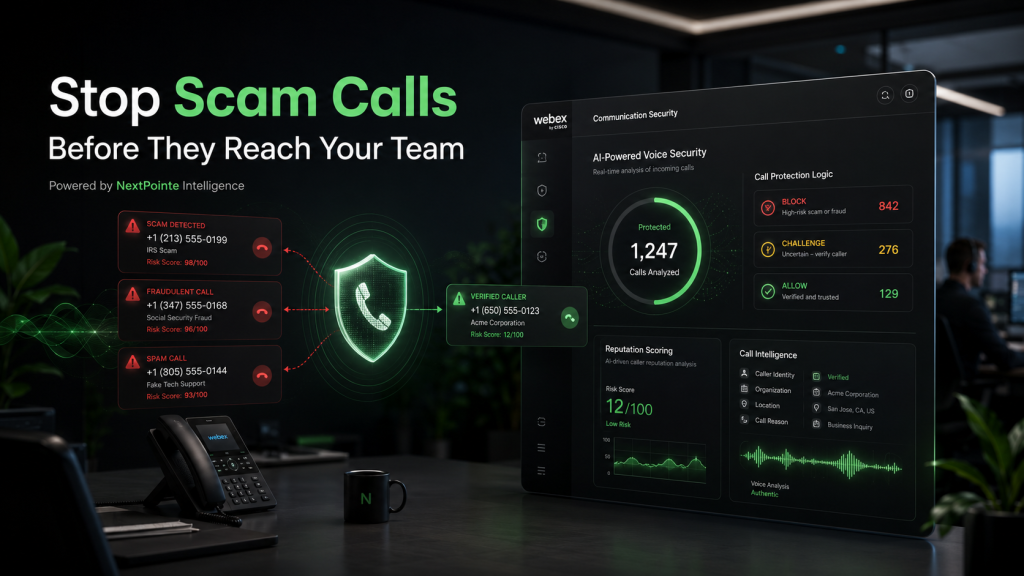
How Real-Time Call Reputation Intelligence Is Transforming Cisco Webex Calling Security
Business communication has changed dramatically over the last few years. While organizations continue investing heavily in email protection, endpoint security, and network monitoring, one critical attack surface is still being overlooked by many companies:
The voice channel
Spam calls, caller ID spoofing, robocalls, AI-generated voice attacks, and fraudulent inbound traffic are becoming increasingly sophisticated. For many businesses, these unwanted calls are no longer just an annoyance. They create operational disruption, consume valuable employee time, damage customer experience, and can even expose organizations to social engineering attacks.
As communication systems become more connected and cloud-driven, companies need smarter ways to identify trusted callers before calls ever reach receptionists, IVRs, call queues, or agents.
That is where real-time call reputation intelligence becomes a game changer.
The Growing Problem with Voice-Based Threats
Most organizations receive dozens, hundreds, or even thousands of inbound calls every day. The problem is that traditional phone systems often treat all calls equally.
A legitimate customer call may arrive through the same path as:
- Spoofed caller IDs
- Robocalls
- Phishing attempts
- Extortion scams
- AI-generated voice attacks
- Nuisance traffic f
- Raudulent automated systems
This creates unnecessary interruptions for teams and introduces serious security concerns for businesses that rely heavily on inbound communication.
Industries such as:
- Healthcare
- Legal services
- Financial firms
- MSPs customer
- Support centers
- Enterprise sales teams
are particularly vulnerable because voice communication is central to daily operations.
What Is Call Reputation Intelligence?
Call Reputation Intelligence is a modern voice security approach that analyzes inbound calls in real time and assigns a reputation score based on multiple threat intelligence sources and behavioral indicators.
Instead of treating every inbound call equally, the system evaluates the likelihood that a call is:
- Legitimate
- Suspicious
- Fraudulent
- Automated
- Spoofed
- High confidence
This allows organizations to automatically decide how calls should be handled before they disrupt employees or customers.

Understanding Voice Traffic Score (VTS)
Voice Traffic Score (VTS) helps organizations apply intelligent reputation scoring to inbound calls within Cisco Webex Calling environments.
Using real-time threat intelligence and configurable thresholds, businesses can automatically:
- Allow trusted calls
- Challenge uncertain calls
- Block high-risk calls
This creates a smarter and more secure inbound calling experience without adding operational complexity.
How the Protection Process Works
The process is designed to be both intelligent and seamless.
1. Real-Time Reputation Analysis
Every inbound call is analyzed using live reputation intelligence and global threat indicators.
2. Reputation Scoring
Calls receive a confidence score based on legitimacy, historical patterns, and threat intelligence data.
3. Automated Policy Enforcement
Administrators define thresholds that determine how inbound calls are treated.
Allow
High-confidence callers are connected normally without interruption.
Challenge
Questionable calls can be validated through additional verification processes before reaching users.
Block
Calls associated with fraud, spoofing, robocalls, or malicious activity can be stopped automatically.
Why Businesses Are Taking Voice Security Seriously
For years, cybersecurity conversations focused primarily on:
- Firewalls
- Ransomware
- Endpoint protection
But attackers have increasingly shifted toward social engineering and voice-based manipulation.
Modern attackers understand that:
- Employees trust phone calls
- Spoofed caller IDs appear legitimate
- Voice communication feels personal and urgent
As a result, businesses are beginning to recognize that protecting the voice channel is now part of a complete security strategy.
Real Benefits for Organizations
Reduced Operational Disruption
Spam and nuisance calls waste valuable employee time every day. Intelligent filtering reduces interruptions before they ever reach staff.
Better Customer Experience
Legitimate customers connect faster while suspicious traffic is filtered automatically.
Stronger Security Posture
Voice security helps organizations strengthen their overall cybersecurity strategy and reduce exposure to social engineering attempts.
Lower Support and Administrative Costs
Reducing unwanted inbound traffic decreases operational overhead and improves productivity across teams.
Smarter Call Handling Policies
Organizations can customize risk tolerance levels based on their business needs and security requirements.
Voice Security and the Zero Trust Model
Many businesses already embrace Zero Trust principles across:
- Endpoints
- Applications
- Cloud environments
- Identity management
However, the voice channel is often left exposed.
Voice reputation intelligence extends Zero Trust principles into business communications by ensuring inbound calls are continuously evaluated before trust is granted.
This creates a more measurable and proactive security approach for modern organizations.
Ideal Use Cases
Voice reputation intelligence is especially valuable for organizations that depend heavily on inbound communications.
Healthcare Providers
Protect front desk teams and reduce spam interruptions affecting patient communications.
Law Firms
Prevent fraudulent inbound activity and improve intake efficiency.
Managed Service Providers (MSPs)
Enhance security offerings for customers using cloud communications.
Financial Services
Reduce exposure to social engineering and spoofing attempts.
Customer Support Centers
Improve agent productivity by reducing nuisance traffic before calls reach queues.
Integrated with Cisco Webex Calling
Modern businesses need solutions that work seamlessly within their existing communication platforms.
Voice Traffic Score integrates directly into Cisco Webex Calling environments, allowing organizations to manage reputation thresholds and call handling policies through familiar administrative workflows.
This creates a streamlined deployment experience while maintaining enterprise-grade flexibility and scalability.
The Future of Business Communications
The future of voice communication is no longer just about connectivity.
It is about:
- Intelligent routing
- Real-time security
- Automated trust decisions
- Proactive threat prevention
- Better customer experiences
Organizations that modernize their voice infrastructure today will be better prepared for the next generation of communication threats.
Scam calls and fraudulent voice traffic are evolving rapidly. Businesses can no longer rely solely on traditional call handling methods to protect employees and customers.
Real-time call reputation intelligence introduces a smarter way to secure inbound communications while improving operational efficiency and customer experience at the same time.
As voice-based threats continue growing, intelligent voice security will become an increasingly important component of modern business communications.
Looking to Improve Voice Security with Cisco Webex Calling?
NextPointe helps businesses deploy fully-assisted communication solutions with advanced voice intelligence capabilities designed for modern organizations.