How to Create and Verify a Meta Business Portfolio So You Can Finally Connect WhatsApp to Your Business
July 30, 2026
How Much Bandwidth Does VoIP Need? Internet Requirements for Business VoIP
August 25, 2026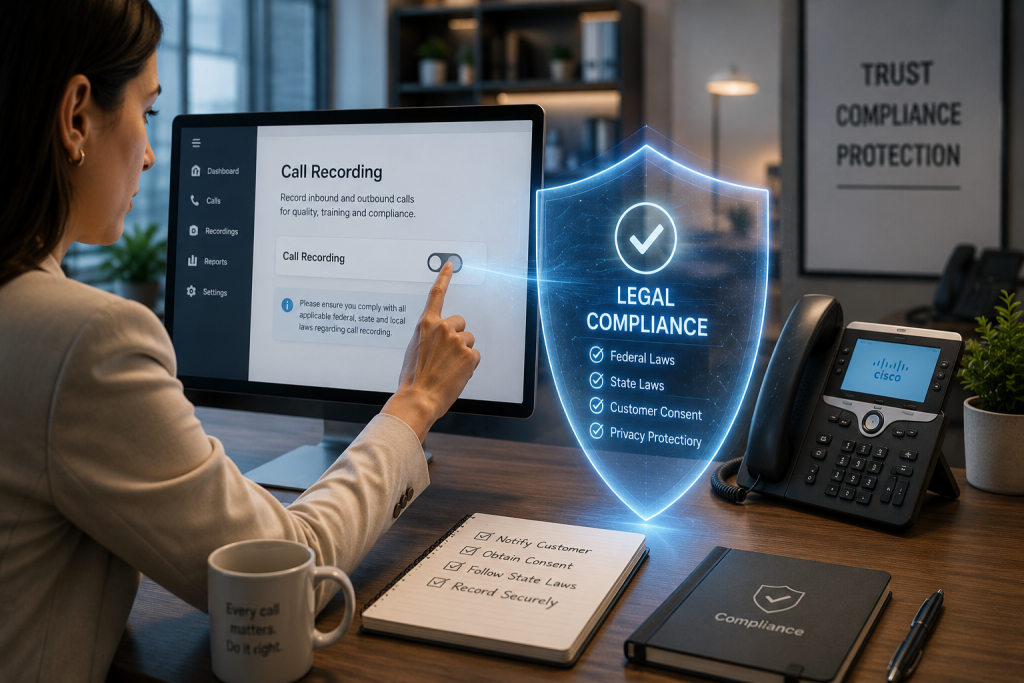
Somewhere in the onboarding process for a new phone system, someone always asks the same question almost as an afterthought: “Can we just turn on call recording for everything?” And almost as often, the honest answer is: it depends on where your customer is sitting when they pick up the phone.
That catches people off guard. Recording a call feels like a technical setting, not a legal one — you flip a toggle in your phone system’s admin panel, and now every call gets saved. But underneath that toggle sits a patchwork of federal and state wiretapping laws that were mostly written before smartphones existed, and they still govern every recorded sales call, support ticket, and intake conversation your business has today. Get it wrong, and you’re not looking at a compliance footnote, you’re looking at real civil and, in some states, criminal exposure.
So let’s actually walk through what call recording consent laws require, in plain English, without the legalese.
A quick note before we go further: we’re a business phone systems company, not a law firm. This is general information to help you understand the landscape; not legal advice for your specific situation. If you operate across multiple states, or your business touches especially sensitive conversations (healthcare, legal, financial), loop in a licensed attorney before you finalize a recording policy.
The federal baseline: one-party consent
Federal law; specifically Title III of the Omnibus Crime Control and Safe Streets Act, later amended by the Electronic Communications Privacy Act sets a floor, not a ceiling. Under federal law, you generally only need the consent of one party to the call to record it legally. Since you, the business, are a party to your own sales and support calls, that consent requirement is satisfied simply by your side agreeing to record.
If federal law were the whole story, this would be a short article. It isn’t, because states are free to set stricter rules, and many of them have.

Call recording consent laws vary a lot by state
A meaningful number of states; usually called “two-party” or “all-party” consent states, even though the rule technically applies no matter how many people are on the call, require every participant to consent, not just one. In those states, recording a call without every participant’s knowledge and agreement isn’t just a policy problem; it can violate the state’s wiretapping statute outright.
Which states fall into that category is exactly the kind of detail that shifts as courts issue new rulings and legislatures amend statutes, so we’re not going to hand you a static list here that could quietly go out of date. For a maintained, state-by-state reference, Justia keeps a 50-state survey of phone recording laws that’s a solid starting point before you finalize a policy, though for anything business-critical, that’s still a conversation for your attorney, not a blog post.
Everywhere else, one-party consent is generally sufficient. But here’s the wrinkle that trips up more businesses than the state-by-state details themselves:
What happens when a call crosses state lines
If your Miami office calls a customer in Illinois, whose law applies, yours or theirs? Courts have gone both ways on this, and the safer, more common practice among businesses with any multi-state footprint is to simply assume the stricter law applies to every call, every time, regardless of where either party happens to be sitting. In practice, that means treating every call as if it needs all-party consent, even when your own state wouldn’t require it.
It’s a more conservative standard than the bare legal minimum in most places, but it’s the one that keeps a single missed detail, a customer’s area code, a remote employee working from an unexpected state, from becoming a real problem.
Florida businesses: you’re already in an all-party consent state
If you’re reading this from Miami, Doral, or anywhere else in Florida, this isn’t a hypothetical for you, it’s the law you’re already operating under. Florida Statute § 934.03 requires the consent of all parties to a call before it can be recorded. For a Florida-based business calling customers who are also in Florida, that requirement is unambiguous. For calls to customers outside the state, it’s another reason the “assume the strictest standard” approach tends to be the practical one, not just the cautious one.
So how do businesses actually get consent?
In practice, almost no company is asking each caller to say “I consent” out loud before every conversation. What businesses actually do, and what courts have generally treated as valid, is play a recorded notice at the start of the call (“This call may be recorded for quality and training purposes”) and treat the customer’s decision to stay on the line as their consent. It’s not a loophole; it’s the accepted standard, because consent doesn’t have to be a formal verbal exchange, it has to be informed and voluntary.
The two things that actually matter in practice:
- The notice has to happen before the recording captures anything meaningful — not buried three menu options into an IVR, and not read so quickly it’s functionally meaningless.
- It has to happen on every call, consistently — not left to whichever rep remembers to say it that day.
That second point is where most call recording policies quietly fail. A written policy that says “agents should mention the call may be recorded” is not the same thing as a system that actually plays the notice automatically, every time, without depending on a person to remember.
Common mistakes worth avoiding
A few patterns show up again and again when businesses get this wrong:
Assuming your own state’s law is the only one that matters. If any of your customers, remote employees, or contractors are in a different state, the calculation changes.
Treating a written policy as the same thing as an automated one. If compliance depends on an agent remembering to say a line, it will eventually not happen, usually on the call you’d least want it to be missing.
Forgetting that internal calls count too. Some states’ consent requirements apply to any recorded conversation, not just customer-facing ones. Recording a call between two employees carries the same requirements as recording a customer call.
Assuming AI features change the legal analysis. They don’t. Whether a human listens to the recording later or an AI transcribes it, summarizes it, and analyzes its tone, the underlying act recording the conversation, is what the law is regulating. A transcript is still a recording.
Where this actually leads
Understanding call recording consent laws is the foundation, but it doesn’t solve the practical problem underneath it: consistency. The businesses that run into trouble usually aren’t the ones that ignored the law, they’re the ones whose recording notice depended on a person remembering to say it, on a system that only recorded some calls, or on a policy that lived in a PDF nobody read after week one.
That consistency is exactly the part NextPointe’s AI Advanced Recordings is built around. Every call gets the same automatic recording notice, every time, without depending on an individual agent, and every conversation is transcribed, summarized, and analyzed for sentiment the moment it ends, logged in one searchable place instead of scattered across whoever happened to take notes. If a recording policy is ever questioned, having a complete, consistent record of every call, not just the ones someone remembered to handle correctly, is the difference between a five-minute answer and a real problem.
If you want call recording that’s consistent by default instead of dependent on memory, take a look at NextPointe’s AI Advanced Recordings, or reach out and we’ll walk you through how it’s set up.